
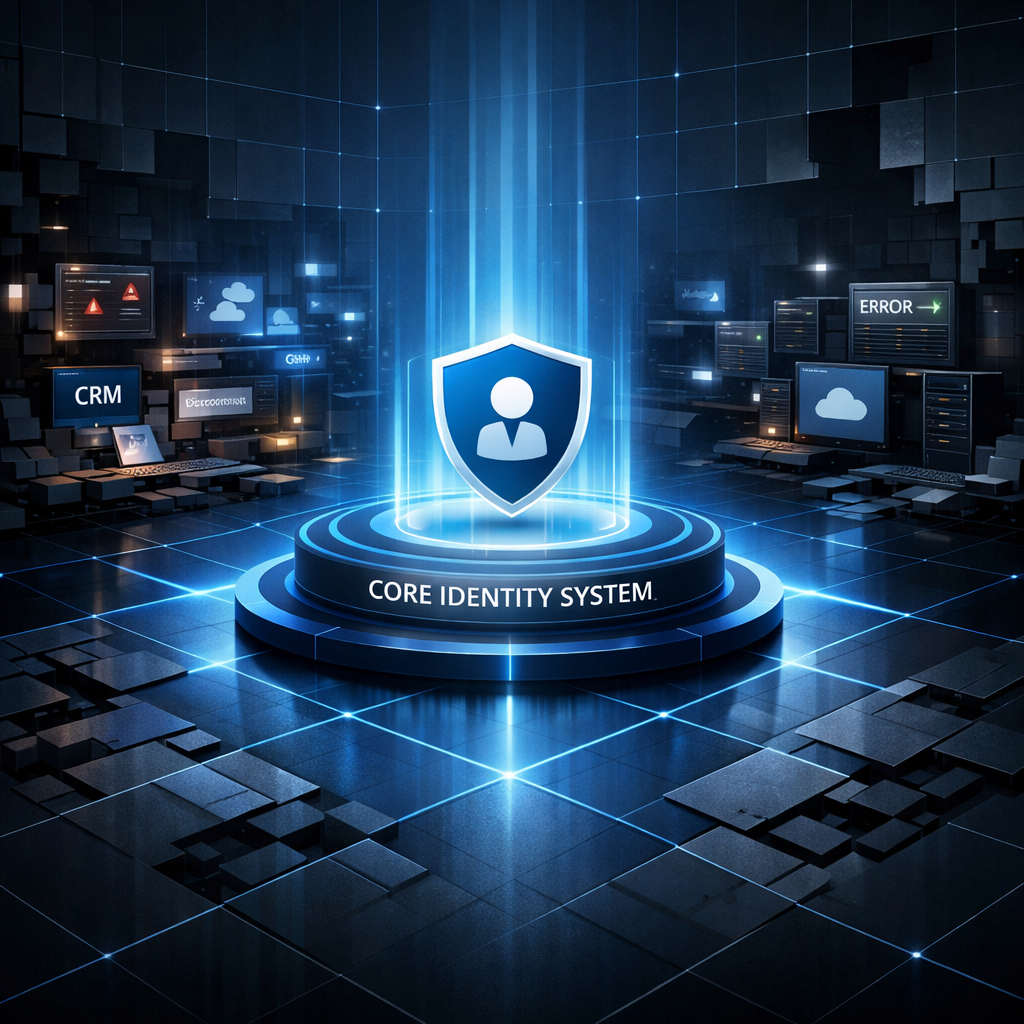
For many enterprises, identity governance for Entra is where governance conversations begin. Microsoft Entra has become the identity foundation for a significant share of enterprise environments. It manages users, enforces access policies, and integrates deeply with Microsoft's broader ecosystem. For many organizations, it is the natural starting point for identity governance.
And that is precisely where the problem begins.
When governance is built around Entra, it creates a perception of centralized control. Certifications run. Policies enforce. Dashboards show coverage. But that control is real only within Entra's boundaries — and enterprise identity environments extend far beyond them.
Centralized identity infrastructure does not guarantee centralized governance.
Why Identity Governance for Entra Often Becomes the Default Model
The logic is straightforward. Entra manages the majority of enterprise identities in Microsoft-heavy organizations. It has native integrations with Microsoft 365, Azure, and a broad range of third-party applications. It offers built-in governance capabilities — access reviews, entitlement management, and lifecycle workflows.
For IT and security teams, it represents the path of least resistance. Entra becomes the center of gravity for governance — not because it was designed to govern the entire enterprise, but because it already manages so much of it.
The result is a governance model shaped by one platform's capabilities and coverage. That model works well within Entra's ecosystem. Outside it, governance becomes inconsistent, incomplete, or absent entirely.
The Assumption: One Identity Platform Can Govern the Enterprise
Behind Entra-centric governance is a broader assumption — that standardizing on a single identity platform creates a unified governance foundation.
It is an assumption worth examining.
Enterprise identity environments are not monolithic. They are the accumulation of years of technology decisions: SaaS applications with native identity systems, legacy platforms that predate modern IAM, customer-facing identity infrastructure, partner and vendor access systems, and cloud workloads with their own access models.
No single identity platform governs all of this. Entra manages what it is configured to manage — which, in most enterprises, is a meaningful but incomplete portion of the full identity estate.
Enterprise identity environments extend beyond any single platform.
When governance is modeled around one system, the parts of the environment that system does not reach become governance blind spots. They do not disappear — they simply go unmanaged.
Where Entra-Centric Governance Becomes Fragmented
The structural gap between Entra's governance scope and the full enterprise identity environment produces fragmentation at four distinct points.
Fragmentation Point 1: Applications Outside the Entra Ecosystem
Not every enterprise application integrates with Entra. Non-Microsoft SaaS platforms, legacy systems, custom-built internal applications, and industry-specific tools frequently manage their own identity and access — outside Entra's governance reach.
Access in these applications is provisioned, modified, and reviewed through different processes — or not reviewed at all. Governance coverage becomes uneven across the application portfolio. Entra governs the applications it knows about. The rest operate outside its control plane.
Fragmentation Point 2: Multiple Identity Systems Across the Enterprise
Most large enterprises do not run a single identity system. Alongside Entra, they operate additional IAM platforms, customer identity systems, and partner or vendor identity infrastructure — each managing a distinct segment of the identity estate.
Governance silos form along system boundaries. Each identity system may have its own access review processes, policy models, and certification workflows. There is no unified governance layer operating across all of them. When governance lives inside one system, every other system becomes a gap.
Fragmentation Point 3: Inconsistent Enforcement Across Systems
Different identity systems apply different policy models and access control logic. What Entra enforces consistently within its scope may not translate to equivalent enforcement in systems outside it.
The same type of access — say, privileged access to a sensitive application — may be subject to rigorous governance controls in Entra-managed systems and minimal controls elsewhere. Control inconsistency becomes structural, not incidental.
Governance becomes consistent within Entra — but inconsistent across everything else.
Fragmentation Point 4: Decentralized Access Provisioning
In large enterprises, access provisioning does not always flow through central IT. Business units manage their own SaaS subscriptions. Local administrators control access to departmental systems. Shadow IT introduces applications that were never brought under central governance.
Access is created and modified outside any centralized governance process. By the time it surfaces — in an audit, an access review, or an incident — it has been operating ungoverned for months or longer. Fragmentation does not just exist at system boundaries. It accumulates wherever provisioning happens outside governed processes.
How Fragmented Governance Creates Risk
Governance fragmentation is not a theoretical concern. It has direct consequences for access risk across the enterprise.
Inconsistent policy enforcement means that identical risk scenarios are managed differently depending on which system is involved. A segregation-of-duties violation that would be flagged immediately in an Entra-governed system may go undetected in a system outside that scope.
Gaps in visibility mean that access risk accumulates silently. Entitlements that have never been reviewed, accounts that have never been certified, and access combinations that span multiple systems — none of these surface in governance processes that are bounded by a single platform.
Uneven control across the environment creates a predictable pattern: risk concentrates at system boundaries, in the spaces between governance models, where no single process has clear ownership.
Risk accumulates at the edges of governed systems — exactly where Entra-centric governance stops.
Why Expanding Entra Coverage Does Not Solve the Problem
A natural response to governance fragmentation is to expand the scope of the central platform — integrating more applications into Entra, extending its reach further across the environment.
This helps at the margins. But it does not resolve the underlying structural issue.
Enterprise identity environments cannot be reduced to a single system. Some applications will not integrate cleanly with Entra. Some identity systems serve business functions that require independence. Some access patterns exist in environments where Entra's governance model does not apply directly.
Integration does not equal governance control. Connecting an application to Entra improves visibility — but it does not automatically bring that application's access under consistent governance logic, policy enforcement, or review workflows.
The enterprise will remain a multi-system environment. Governance built around any single system within that environment will produce fragmentation as a structural outcome.
What Unified Identity Governance for Entra Environments Requires
Governance that operates consistently across an enterprise multi-system environment — including those built around identity governance for Entra — requires a different architectural approach. One that is not anchored to any single identity platform.
- System-agnostic visibility — the ability to ingest and evaluate identity and access data from Entra, other IAM systems, SaaS applications, and legacy platforms within a single governance layer, regardless of the underlying platform
- Centralized policy logic — governance policies defined and enforced at a layer above individual identity systems, so that the same rules apply consistently regardless of which system manages a given identity or application
- Consistent enforcement across platforms — access reviews, certifications, and policy decisions that operate uniformly across the environment — not according to what each system natively supports
- Cross-system access visibility — the ability to evaluate access risk across system boundaries, identifying entitlement combinations and policy violations that only become visible when the full identity estate is viewed together
Governance must operate above identity systems — not within them.
This is not about replacing Entra or reducing its role. Entra remains a critical piece of enterprise identity infrastructure. The shift is in where governance lives — above the platform layer, not inside it.
How This Connects to Identity Governance for Entra
Entra plays an important and legitimate role in enterprise identity infrastructure. The argument here is not that Entra is inadequate — it is that identity governance for Entra cannot be bounded by Entra's scope if it is to operate consistently across the enterprise.
A governance layer that operates above identity systems can work with Entra as a data source and enforcement point — while extending the same governance logic to every other system in the environment. Entra's capabilities are preserved and leveraged. Governance is no longer constrained by them.
→ Explore how identity governance works across Entra and beyond — Identity Governance for Entra
Governance Must Extend Beyond the System It Starts In
Platform-centric governance produces platform-bounded control. For enterprises relying on identity governance for Entra, this means governance that works well within Entra's ecosystem — and creates fragmentation everywhere else.
Not because Entra is insufficient, but because enterprise environments are inherently multi-system, and no single platform can govern all of them uniformly.
The enterprises closing governance gaps are those that have moved governance above the platform layer — making it independent of any single system's scope, data model, or workflow architecture.
Identity governance fails wherever control does not extend across systems.
FAQ - Frequently Asked Questions
What is identity governance for Entra, and what are its limitations?
Identity governance for Entra refers to using Microsoft Entra as the primary platform for managing access certifications, policy enforcement, and lifecycle governance. Within Entra's ecosystem, this works effectively. However, enterprise environments include applications, identity systems, and access patterns that exist outside Entra's scope — making Entra-centric governance incomplete at enterprise scale.
Can Entra provide complete identity governance for enterprises?
Entra provides strong governance capabilities within its ecosystem. However, most enterprise environments include applications, identity systems, and access patterns that exist outside Entra's scope. Governance centered on Entra will be consistent within that scope — and fragmented or absent beyond it.
What causes fragmented identity governance?
Fragmented governance is a structural outcome of platform-centric governance models. When governance logic, policy enforcement, and access visibility are bounded by a single identity system, every system outside that boundary operates under different — or no — governance controls. Fragmentation grows as enterprise environments grow in complexity.
Why is identity governance inconsistent across systems?
Inconsistency arises because different identity systems apply different policy models, access controls, and review processes. Without a governance layer that operates above all systems and enforces consistent logic regardless of platform, governance outcomes will vary by system — producing control inconsistency at scale.
How do enterprises unify identity governance across platforms?
Unified governance requires a system-agnostic layer that ingests identity and access data from all platforms — including Entra — applies centralized policy logic, and enforces consistent controls regardless of the underlying identity system. This layer operates above platforms like Entra, not within them, enabling governance that spans the full enterprise identity estate.
What is the role of Entra in enterprise identity governance?
Entra is an important component of enterprise identity infrastructure — managing a significant share of identities, enforcing access policies, and providing native governance capabilities within its ecosystem. In a unified governance model, Entra functions as a data source and enforcement point within a broader governance layer that extends across all identity systems in the enterprise.