

Key Takeaways:
- NIST 800-63-4 government authentication requirements became effective in August 2025, superseding the 2017 revision most agencies have been implementing against.
- AAL2 now requires agencies to offer at least one phishing-resistant MFA option. SMS OTP alone no longer satisfies the full requirement.
- The Digital Identity Risk Management framework introduces continuous assurance level assessment as a normative requirement, replacing the static configuration model of 800-63-3.
- Syncable authenticators including passkeys are now explicitly addressed, opening a viable path to phishing-resistant authentication at citizen scale.
NIST 800-63-4 government authentication requirements became the federal standard in August 2025, superseding the 2017 revision that most government agencies have been implementing against for nearly a decade. For agencies that have not reviewed their citizen authentication configuration since 800-63-3, the revision creates a compliance gap. Not because the framework overhauled everything, but because specific requirements shifted in ways that have direct operational consequences for how citizen-facing portals authenticate users today.
This post is not a comprehensive summary of every change in the revision. It is a practical brief for the IT security manager, enterprise architect, or CISO who knows that NIST SP 800-63-4 government authentication requirements have changed and needs to understand what that means for their current configuration. Specifically: which requirements shifted, which existing implementations may no longer be fully compliant, and what the platform-level implications are. Three changes have the most immediate operational impact. Each one is addressed in turn.
What Changed in NIST 800-63-4 Government Authentication Requirements
The 800-63-4 revision shifts the fundamental expectation from one-time configuration to continuous risk management across three operationally significant areas.
The 800-63-4 revision is best understood not as a checklist update but as a philosophical shift in how NIST expects agencies to approach digital identity risk. The 2017 version treated assurance level selection largely as a configuration decision made at system implementation. The 2025 revision introduces continuous risk management as a normative requirement, addresses authenticator technologies that did not exist or were not clearly scoped in 2017 and tightens the requirements for what satisfies AAL2 in citizen-facing deployments.
Three changes carry the most direct operational weight for agencies currently running citizen authentication infrastructure.
NIST 800-63-4 AAL2 Government Authentication Now Requires a Phishing-Resistant MFA Option
AAL2 now requires agencies to offer at least one phishing-resistant MFA option, meaning SMS OTP alone no longer satisfies the full requirement.
This is the change with the most immediate impact for the largest number of agencies.
Under NIST 800-63-3, AAL2 could be satisfied through a range of multi-factor authentication methods, including SMS one-time passwords. SMS OTP was broadly deployed across citizen-facing portals precisely because it requires no hardware distribution, works on any mobile device, and presents minimal onboarding friction for large and diverse citizen populations.
Under NIST 800-63-4, agencies must offer users at least one phishing-resistant MFA option at AAL2. Phishing-resistant authenticators are those that cryptographically bind the authentication response to the specific relying party, making credential interception and replay attacks structurally impossible. FIDO2 security keys, passkeys, and PIV credentials satisfy this requirement. SMS OTP does not.
This does not mean SMS OTP is prohibited under 800-63-4. It means that an agency offering only SMS OTP as its second factor no longer satisfies the full AAL2 requirement. Agencies must make a phishing-resistant option available to users, even if SMS OTP remains as an alternative for users who cannot or do not use phishing-resistant authenticators.
For agencies that deployed SMS-based MFA as their primary second factor for citizen authentication, this is the most immediate gap to address. The practical question is not whether to remove SMS OTP but whether the current platform can support FIDO2 or passkey-based authentication as a citizen-facing option alongside existing methods.
AAL3, required for high-value government services such as those involving sensitive benefits determinations, law enforcement records, or high-consequence financial transactions, continues to require hardware-based, phishing-resistant authentication. FIDO2 security keys and PIV credentials remain the primary paths toward AAL3 when implemented with appropriate configuration. The specific mapping depends on implementation configuration and agency risk assessment, and AAL3 cannot be satisfied by software-based authenticators alone.
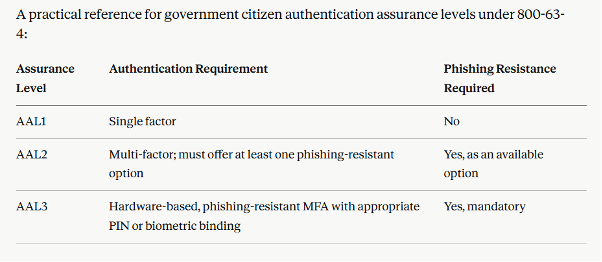
Note: AAL3 mapping to specific authenticators depends on implementation configuration and agency risk assessment.
NIST 800-63-4 Digital Identity Risk Management: From One-Time Selection to Continuous Assessment
The DIRM framework makes assurance level assessment an ongoing normative obligation, replacing the static configuration model most agencies have been operating against.
The second operationally significant change in 800-63-4 is the introduction of the Digital Identity Risk Management framework as a normative requirement for how agencies select and maintain assurance levels over time.
Under 800-63-3, assurance level selection was primarily a system implementation decision. An agency assessed the risk profile of a service, selected the appropriate IAL and AAL, configured the system accordingly, and documented the decision. That configuration was then expected to remain stable unless a material change in the service triggered a formal reassessment. In practice, those reassessments happened infrequently.
NIST SP 800-63-4 treats Digital Identity Risk Management as an ongoing process rather than a point-in-time decision. Agencies are expected to continuously evaluate whether the assurance level applied to a service remains appropriate as the threat environment evolves, the service scope changes, or the user population shifts. This is a meaningful departure from the static configuration model that most agencies have been operating against.
A CIAM platform that enforces a fixed assurance level configuration, set at implementation and unchanged until manually reconfigured, is not architecturally aligned with the DIRM framework's expectation of dynamic, risk-responsive policy enforcement. The platform must be capable of evaluating risk signals at runtime and escalating authentication requirements when risk context changes, without requiring manual reconfiguration for each escalation event. For agencies currently using platforms that apply a single authentication policy uniformly across all citizen interactions, the DIRM framework signals that this model is no longer the standard NIST expects.
Adaptive authentication, where authentication requirements for a specific interaction respond to real-time risk signals rather than a fixed policy assignment, is consistent with the DIRM framework's expectation of continuous, risk-responsive assurance level management.
NIST 800-63-4 Syncable Authenticators and Passkeys: Now Normatively Addressed
Passkeys and syncable authenticators are now explicitly covered by normative requirements in 800-63-4, resolving the compliance ambiguity that prevented many agencies from deploying them.
The third operationally significant change in 800-63-4 is the explicit normative treatment of syncable authenticators, the technology category that includes passkeys for government digital services stored in device credential managers such as Apple Keychain, Google Password Manager, and Windows Hello for Business.
Under 800-63-3, syncable authenticators occupied an ambiguous position. The framework predated their widespread availability, and agencies seeking to deploy passkey-based authentication for citizen services had limited normative guidance to rely on. NIST SP 800-63-4 resolves this ambiguity with explicit requirements for the use of syncable authenticators, including conditions under which they satisfy phishing-resistant authentication requirements and specific implementation considerations for their use in government digital services.
The practical significance for citizen-facing government services is substantial. Hardware security key distribution at citizen scale has historically been both logistically complex and a source of accessibility friction for populations with limited technical familiarity. Passkeys stored in device credential managers eliminate the hardware distribution requirement while still providing cryptographic phishing resistance, provided the implementation meets the normative requirements specified in 800-63-4 for syncable authenticators. For agencies managing large and diverse citizen populations, this opens a viable path to phishing-resistant authentication at scale that was not clearly available under the previous revision.
What NIST 800-63-4 Means for Your Current Government CIAM Platform
Agencies should assess their current platform against four specific questions that the 800-63-4 revision makes directly relevant to their compliance posture.
Agencies operating citizen-facing portals should assess their current configuration against four specific questions that the 800-63-4 revision makes directly relevant.
Does the platform support FIDO2 PIV government authentication and passkey-based authentication for citizen users? If the platform was implemented against 800-63-3 assumptions, FIDO2 and passkey support may not have been a procurement requirement at the time. Confirming whether this capability exists in the current platform, and whether it can be enabled for citizen-facing applications without a separate deployment, is the first assessment to complete.
Can the platform enforce phishing-resistant MFA as an available option at AAL2 without requiring a parallel deployment or significant custom integration? The new AAL2 requirement is not satisfied by confirming that phishing-resistant options exist somewhere in the environment. They must be available to citizen users through the same authentication flow that currently serves them.
Does the platform support risk-based authentication that can dynamically escalate assurance levels at runtime, consistent with the DIRM framework? A platform that applies a fixed authentication policy uniformly across all citizen interactions is not architecturally aligned with the DIRM framework's expectation of continuous, risk-responsive assurance level management.
Does the platform produce a centralized audit trail of the assurance level applied to each authentication event, in a format suitable for FISMA and FedRAMP documentation requirements? DIRM's continuous assessment model implies that agencies must be able to demonstrate, across time, that authentication decisions were consistent with the assurance level requirements applicable to each service and each interaction. A fragmented or application-level audit trail does not support this documentation requirement.
Where Agencies Should Focus First on NIST 800-63-4 Government Authentication Compliance
Three self-assessments should be completed before the next compliance review cycle to identify the highest-priority gaps the revision creates.
Agencies operating citizen-facing portals under 800-63-3 assumptions should complete three self-assessments before their next compliance review cycle.
First, verify whether the current CIAM configuration satisfies the new AAL2 phishing-resistant requirement. If the platform's AAL2 implementation relies exclusively on SMS OTP or other non-phishing-resistant factors, addressing this gap is the highest priority item the revision creates.
Second, assess whether the platform supports DIRM-compatible dynamic policy enforcement. If the current platform applies static assurance level configurations that cannot respond to runtime risk signals, the platform's architecture is not architecturally aligned with where NIST 800-63-4 positions the standard.
Third, confirm whether passkey-based authentication is available as a citizen-facing option within the current platform. Given the normative clarity 800-63-4 now provides on syncable authenticators, agencies that previously avoided passkeys on the basis of unclear compliance status should revisit that decision.
For a full treatment of how governed CIAM enforces NIST 800-63-4 government authentication requirements for citizen-facing digital services, including PIV authentication, FIDO2 support, adaptive authentication aligned to the DIRM framework, and centralized audit trail requirements, see the CIAM for Government page. For agencies evaluating how NIST 800-63-4 compliance fits within a broader governed CIAM architecture for regulated environments, the CIAM for Regulated Industries pillar covers the full governance model.